Max
Max Ernest Balchowsky was born in Fairmont, West Virginia, on January 15, 1924. His first job, at twelve, was lacing spoked rims in a bicycle shop, where everything mechanical fascinated him. In World War II he flew as a B-24 belly gunner, was slightly injured after bailing out over friendly territory in the European campaign, and was reassigned to the Orient for the Burma campaign.
After the war Max headed west, encouraged by his older brother Casper, who ran a filling station and transmission shop in South Gate, California. With the GI Bill in hand he took night classes in watch repair in Glendale, and washed dishes at Algemac’s Coffee Shop for 75 cents an hour. Hot rodders and bikers filled Algemac’s. Glendale was a hotbed of the great speed merchants of the day: Ed Winfield (who would influence Max tremendously), Kong Jackson, Barney Navarro, and clubs like the Sidewinders and the Comets.
Max and Casper became a “hot” street-racing duo. Driving a roadster past a local high school, Max noticed a beautiful young girl named Ina Wilson, whose father had an auto repair shop nearby. Max and Ina married in 1949.
Hollywood Motors
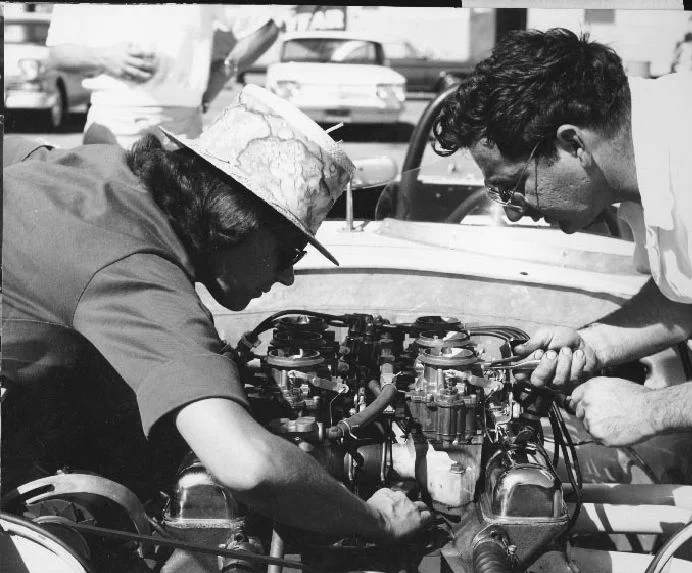
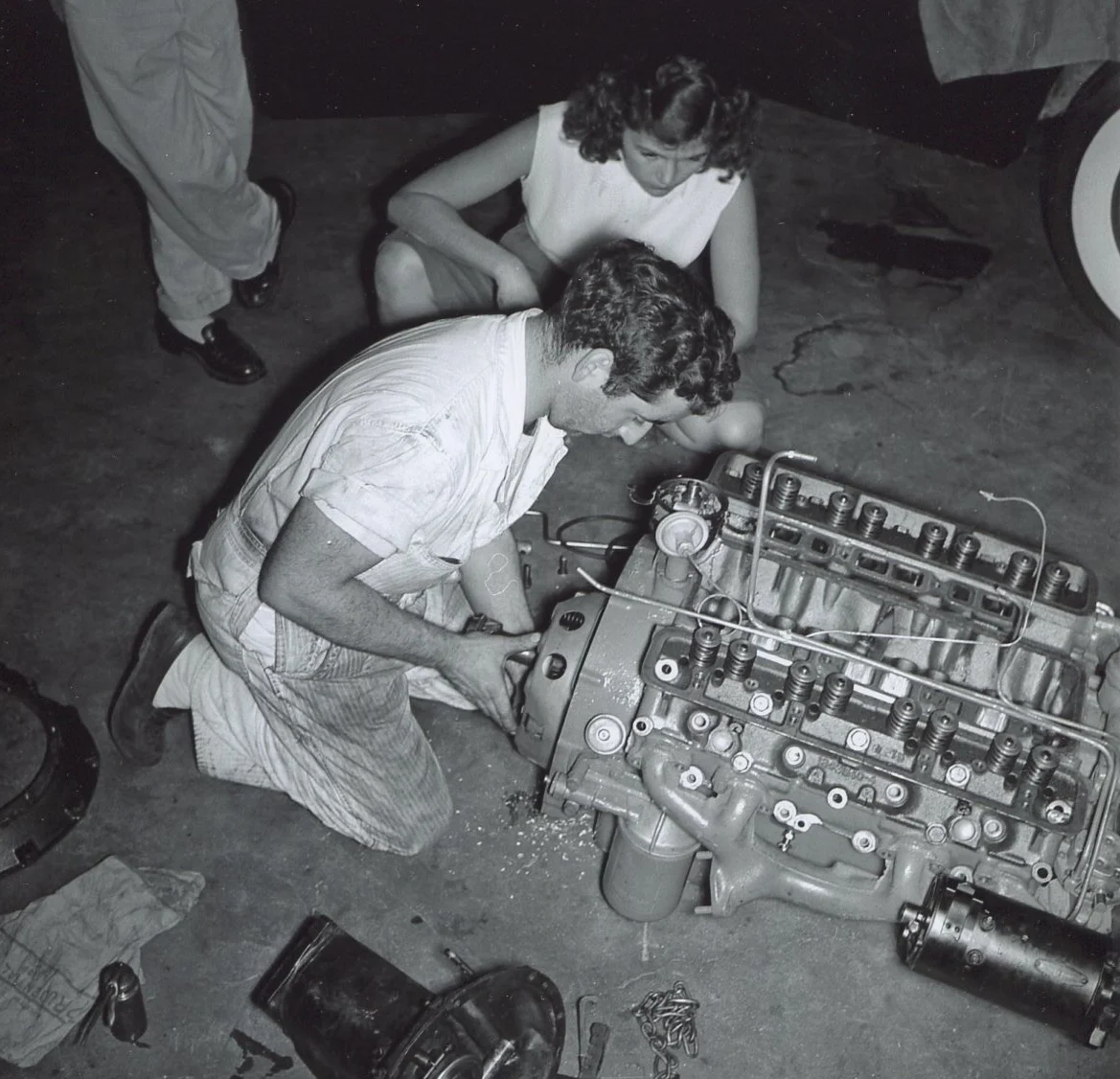
That same year they opened the soon-to-be-legendary Hollywood Motors at 4905 Hollywood Boulevard. Max became known as the master of the engine transplant, which was hugely popular with hot rodders, and would routinely drop a Cadillac or Buick into anything. One early Hollywood Motors letterhead carried the slogan:
“We can replace anything with anything.”Hollywood Motors letterhead
Several hot rod magazines ran features on Max and his routine engine swaps. He was known, too, for a network of some of the most creative and skilled fabricators and machinists in Southern California.
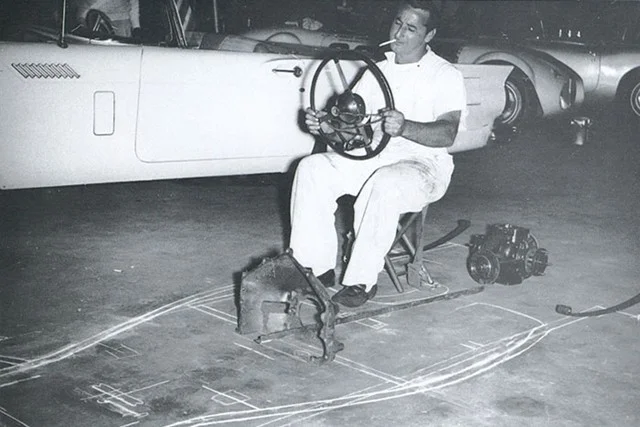
The specials before
From 1951, Ina and Max were active in sports car racing, starting with Bill Harrah’s Jaguar XK120 at the Reno road races. Their first modified road racer was Jimmy Summers’ channeled ’32 Ford, the Bu-Ford Special, which raced across California including the Pebble Beach road races. Ina called it “Whistling Willy” for the sound of the wind across its nose. Its 600-lb, 322-cubic-inch 1954 Buick made an effortless 310 asphalt-ripping horsepower on 91-octane gas.
Next came the Swallow Doretti, a limited-edition English sports car based on the Triumph TR2. Only 273 were built, in 1954–55, by Swallow Coachbuilding of Walsall, on a tubular frame with aluminum panels. Max modified several for road racing, swapping the stock 1991cc pushrod four for the mighty Buick and a Jaguar gearbox. The “Buretti” was fast, but its short wheelbase and difficult steering were a struggle.
Then the Morgensen Special. Dick Morgensen and Boyd Hough had welded it up from chrome-moly tubing in a truss-ladder frame, with surplus aircraft joints, 1940 Ford steering, a scooter windscreen, Buick-Lincoln brakes, Ford spindles and rear axle, and a DeSoto six (later a Plymouth). When his friend crashed it, Max took it over and changed, by his own account, everything except the steering wheel and seat. He fitted the Buick, cobbled up aluminum panels for lightness, and shared the driving with partner Eric Hauser. They worked through an experimental brake system using domestic drums with Fren-do lining, new steering geometry, axle hop, and a log-type intake manifold that the Weiand company went on to copy.
The Morgensen Special had a very low center of gravity and weighed 1,610 lb, but the DeSoto six left it underpowered. With the Buick engine and Buick aluminum drum brakes, it became a winner. In 1958, at Santa Barbara, Max broke the lap record held by Lance Reventlow’s no-expense-spared Scarab. It was a defining moment. Max and Ina were convinced it didn’t take mega-bucks and a ton of engineers to be competitive in major sports car racing.
Why “Old Yeller”?
Lester Nehamkin, a Hollywood studio photographer who loved hanging around Hollywood Motors, chronicled the cars for Max and Ina and is said to have coined the name Old Yeller for the Morgensen Special. The yellow paint soon followed. Old Yeller was the 1957 Disney film, starring Dorothy McGuire and Fess Parker, about a loyal stray dog who saves his family from a rabid wolf. There was nary a dry eye in the theater. Journalists often mangled the name into “Ol’,” “Ole” or “Yaller.” Back at the shop, Max and Ina were usually found with their own ever-faithful Golden Retriever, Ted.
The Buick Nailhead
Every car Max raced taught him something. His Studebaker street racer showed that a hot car didn’t have to be a Ford or Chevy, and the Studebaker Champion solid rear end, with its wide choice of ratios, went into Old Yeller II. The Bu-Ford proved he could run at the front, but it had poor brakes and a high center of gravity. The Doretti’s short wheelbase and steering taught him to favor quick Morris Minor steering, used by all the road-racing special builders.
Lou Blaney was the master of the OHV Cadillac, Gene Adams worked magic with Oldsmobiles, and Mickey Thompson pumped up Pontiacs. Max was the Buick guru, building magical Buicks for everything from dragsters to power boats. In 1953 Buick replaced its straight eight with an OHV V8; the 364 brought great torque, and the 1959 401 Nailhead had even more low-end grunt. Its pent-roof chambers, domed pistons and vertical valves allowed high compression without high octane. The “Nailhead” name came from those small, upright valves, which also limited breathing. Buick kept gas velocity high with small ports, long-duration cams and a very light valve train, peaking at about 5,300 rpm stock.
Unmarked crates of Buick motors arrived at Hollywood Motors stamped “For Industrial Use.” The constant enemy was heat. Max wrote to John Burnside, a service engineer at Buick in Flint, Michigan:
“For the first five laps or so, the big Ferraris and Maseratis cannot touch me, either in acceleration or straightaway speeds… as the temperature increases and the horsepower falls off, I can lose 200–300 rpm on the straightaway… this is 5–8 mph, or one half second a lap.”Max Balchowsky, letter to Buick
His tricks were loose valve settings and the biggest radiator that would fit. The heads couldn’t be modified much, so Ed Winfield designed and ground the camshafts for every Balchowsky road-racing motor. Asked in 1960 whether he’d build something with a smaller engine, Max said: “I can’t find an inexpensive small engine with any possibilities.” The only substitute for cubic inches is more cubic inches.
Max was one of the first to check tire hardness with a durometer. He worked with Gardner-Reynolds on special recaps, pulled from the curing mold 5 to 10 minutes early for a softer compound. Sometimes Old Yeller would throw a tread mid-experiment.